



What Makes a Keyword Worth Targeting? 3 Things I’ve Learned in 8 Years of SEO
I’ve been working in digital marketing for about eight years now, and SEO has changed a lot in that time. The way Google works has changed, the way people search has changed, and now we’re having a whole new conversation about AI search and how people find information.
But when I’m doing keyword research, I still come back to the same basic question: is this actually a keyword worth targeting?
As a company principal, we talk a lot about not doing “snake oil” marketing. We want to be able to explain why we’re recommending something and how it is actually going to help a client. Keyword research is a good example of that.
There are three things I look at when deciding whether a keyword makes sense.
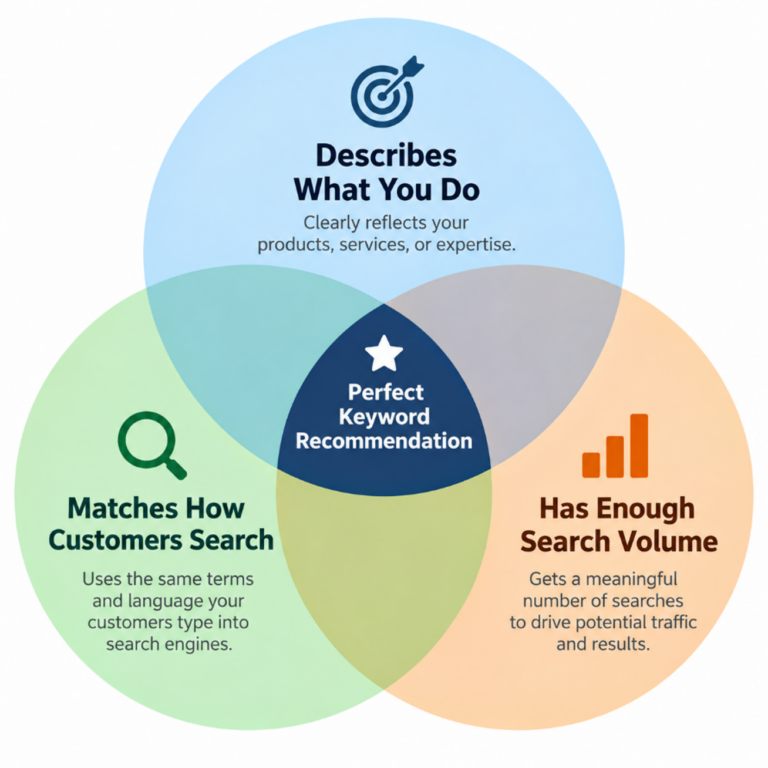
1. Does it actually describe what you do?
First, the keyword needs to make sense for the business.
That probably sounds obvious, but there are plenty of keywords with high search volume that aren’t necessarily relevant to what a business offers. That, or they aren’t specific enough for it to show relevant search results. I don’t want to bring someone to your website just because they searched something with a lot of traffic behind it. I want them to actually be looking for what you sell.
2. Is that how your customer would actually search for it?
This is probably where I see the most interesting conversations happen during keyword research with clients.
Businesses often have their own terminology for their products or services, and sometimes that terminology is completely different from what their customers would type into Google.
You might have a very specific, technically accurate term for your service. However, if your customers don’t use that term, optimizing your site around it isn’t going to do you much good. In my experience, there have been many times that we recommend against the keyword the client wants because most people wouldn’t type that technical or niche phrase into Google.
We’ve run into this a lot with more niche businesses. We have found ways to work around this. For example, there are times when the answer isn’t choosing one term over the other. We might use the industry terminology in certain places while also incorporating the language people are actually using to search.
Because ultimately, it doesn’t matter what we think the service should be called if that’s not what people are searching.
3. Is there actually search volume?
This one is pretty straightforward: there needs to be some search volume behind the keyword.
I’ve done plenty of keyword research where we find a term that seems perfect at first. It describes the service exactly, and it sounds like something a potential customer would search. However, then we look at the data and find that almost nobody searches for it.
You can rank number one for a keyword like that, but if nobody is searching for it, the ranking isn’t doing much for you.
So what makes a keyword worth targeting?
For me, it’s really the combination of those three things:
Does it describe what you offer? Does it match how people actually search? And is there enough search volume to make it worth targeting?
That’s why we spend a good amount of time on keyword research at Magnetic North. We’re looking at all three pieces rather than simply finding keywords with the highest search volume or choosing the terminology a business uses internally.
Sometimes those things line up perfectly. Sometimes they don’t, and we have to find the middle ground.
That’s where I think good keyword research adds a lot of value. It isn’t about finding a keyword we can rank for. It’s about finding the right keyword to rank for. Because at the end of the day, a number-one ranking only matters if it helps the right people find your business.


digital marketing strategist, team lead
ABOUT THE AUTHOR
Megan Sternke
Megan is a Digital Marketing Strategist here at Magnetic North. In her time here she has explored her interests in campaign development & execution, graphic & web design, and social media marketing. One of her favorite parts of her job is fostering relationships with clients and finding new ways to bring value to her accounts.