



Why Has My Website Traffic Been Declining Since 2025?: Understanding the Impact of AI on SEO
If you have noticed a decline in organic traffic recently, you are not alone.
Many businesses are experiencing similar trends. In most cases, this is not due to a technical issue or a failure in your SEO strategy. Instead, it reflects a broader shift in how people search for and consume information online.
What Is Changing in Search Behavior?
Search engines are increasingly incorporating AI-generated summaries directly into results pages.
When users search for a question, they are often presented with a complete answer at the top of the page. This reduces the need to click through to individual websites.
As a result:
- Users are finding answers more quickly
- Fewer users are visiting websites for general information
- Your content may still be used, but not always credited with a visit
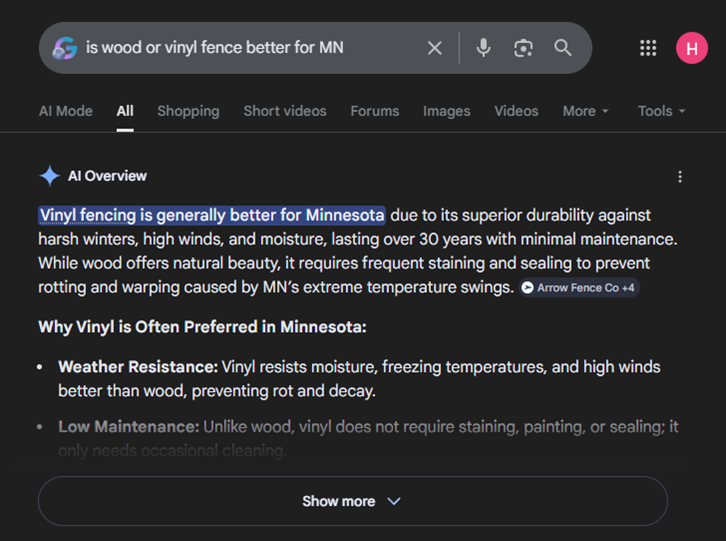
Example: User gets their answer on Google, never visiting your site.
In many cases, these AI-generated responses are built from content similar to what businesses have already published.
The Limitations of Traditional SEO
Historically, SEO strategies focused on three primary actions:
- Creating helpful, informative content
- Targeting relevant keywords
- Driving traffic through search rankings
This approach remains important, but it is no longer sufficient on its own.
For example, a search like “10-year cost of wood vs. composite deck” may now be answered directly within the search results. This reduces the opportunity for individual websites to capture that traffic, and get brand exposure.
Content that provides general, widely available information is becoming less effective as a primary traffic driver.
How to Adapt Your Approach
Rather than moving away from SEO, businesses should expand their approach to align with these changes.
The following areas are increasingly important:
1. Evaluate Your Presence in AI-Driven Results
Start by using AI tools such as:
- ChatGPT
- Google Gemini
- Perplexity
Search for queries that your potential customers would use, including:
- “Best [your service] company near me”
- “Who is [your business name]?”
- “Top companies for [your service] in [your city]”
Then assess the results:
- Is your business mentioned?
- Is the information accurate and complete?
- Does it clearly represent your services?
If your business is not well understood by these systems, it becomes more difficult to appear in AI-driven recommendations.
2. Identify AI as an Emerging Traffic Source
AI platforms are beginning to refer users to external websites. However, this traffic is often overlooked.
Review your analytics to determine:
- Whether AI tools are sending users to your site
- Which platforms are contributing traffic
- Which pages are receiving these visits
While this traffic may still be limited, it is likely to grow and should be monitored early.
3. Measure Lead Generation from AI Traffic
Traffic alone is not the primary objective. The focus should remain on lead generation and business outcomes.
Key questions to consider include:
- Are any leads originating from AI-related traffic sources?
- How does this traffic compare in quality to other channels?
- Are these leads converting at a similar or higher rate?
Understanding this will help determine the true value of AI-driven visibility.
Expanding Beyond Your Website
One of the most significant changes is how information is evaluated.
AI systems do not rely solely on your website. They assess your broader digital presence, including:
- Google Business Profile
- Online reviews
- Directory listings
- Mentions across third-party websites
- Published articles or media coverage
Consistency across these sources is essential. Conflicting or incomplete information can reduce credibility and visibility.
Learning from Competitors
AI systems continuously compare businesses when generating recommendations.
To better understand your position, search for:
- “Best [service] company near me”
- “Top [industry] providers in [city]”
If your business does not appear, review those that do:
- Where are they mentioned online?
- How consistent is their information?
- What signals might indicate trust or authority?
This can provide practical insight into areas for improvement.
A Shift in Strategy
SEO is not disappearing, but it is evolving, and AEO is becoming increasingly important.
Relying solely on general informational content is becoming less effective. Businesses should focus on:
- Building a strong and consistent digital presence
- Ensuring accurate representation across platforms
- Understanding how new sources of traffic contribute to leads
Where to Begin
To take a practical first step:
- Search for your business using AI tools
- Review your analytics for AI-related traffic
- Evaluate how leads are being generated and tracked
These actions can help establish a baseline and identify opportunities for improvement.
Final Perspective
AI is reshaping how users interact with search, but it does not eliminate the need for SEO.
It increases the importance of clarity, consistency, and credibility across your entire digital presence.
Businesses that recognize and adapt to this shift will be better positioned to maintain visibility and generate meaningful results over time.
If your website traffic has been declining and you are not sure why, let’s talk. Our team can help you understand what is changing and build a strategy that keeps your business visible. Contact us to get started.


digital marketing strategist, team lead
ABOUT THE AUTHOR
Hunter Krueger
Hunter graduated from the University of Minnesota in 2021 with a degree in Marketing. His entrepreneurial spirit and dedication to creating led him to start a video marketing business at 15, creating videos for businesses, schools, and TV. Through this, he found his passion for marketing and has since worked on marketing campaigns for businesses in different industries across the country. Outside of work, you'll find Hunter at Lifetime, doing home improvements with his wife, and working on new video projects on the weekends.